



L’acai bowl s’est imposé comme une préparation incontournable dans l’univers des petits-déjeuners et collations équilibrés, particulièrement auprès des sportifs et des personnes actives. Composé principalement de pulpe d’açaí mixée, ce bol se distingue par sa texture épaisse et ses possibilités de personnalisation grâce aux fruits, graines et autres garnitures que l’on peut y ajouter.
Malgré sa popularité, de nombreuses questions subsistent sur sa composition, ses calories et son adaptation aux besoins nutritionnels, notamment dans un contexte sportif. Quelles sont les variantes possibles pour un petit-déjeuner avant l’entraînement ? Comment le préparer après l’effort pour un apport équilibré en énergie et en protéines ? Quels choix de toppings privilégier pour un acai bowl complet sans excès énergétique ?
Cet article propose un guide détaillé sur l’acai bowl : il explique ce qu’est l’açaí, présente des recettes simples et modulables, détaille les apports énergétiques selon la composition, et fournit des conseils pour adapter cette préparation aux différents profils et objectifs.
Acai bowl : c’est quoi exactement ?
L’acai fruit, une baie cultivée en Amazonie
L’açaí est une petite baie de couleur violette issue du palmier Euterpe oleracea, une espèce native des zones tropicales humides d’Amérique du Sud. Ce palmier est principalement cultivé dans le bassin amazonien, notamment au Brésil, mais aussi dans certaines régions de la Colombie, du Pérou et du Venezuela. Il pousse dans des zones inondables, le long des fleuves, où les conditions climatiques sont chaudes et très humides.
Dans son contexte traditionnel, l’acai est consommé depuis des siècles par les populations locales, essentiellement sous forme de purée épaisse, souvent associée à des aliments salés ou à des sources de glucides comme le manioc ou le riz. Cette consommation diffère largement de l’usage occidental, davantage orienté vers des préparations sucrées.
En raison de sa forte périssabilité, l’açaí est rarement consommé frais en dehors de sa zone de production. Il est donc exporté et commercialisé principalement sous les formes suivantes :
- pulpe surgelée, considérée comme la forme la plus proche du fruit d’origine,
- poudre lyophilisée,
- purée prête à l’emploi, parfois pasteurisée.
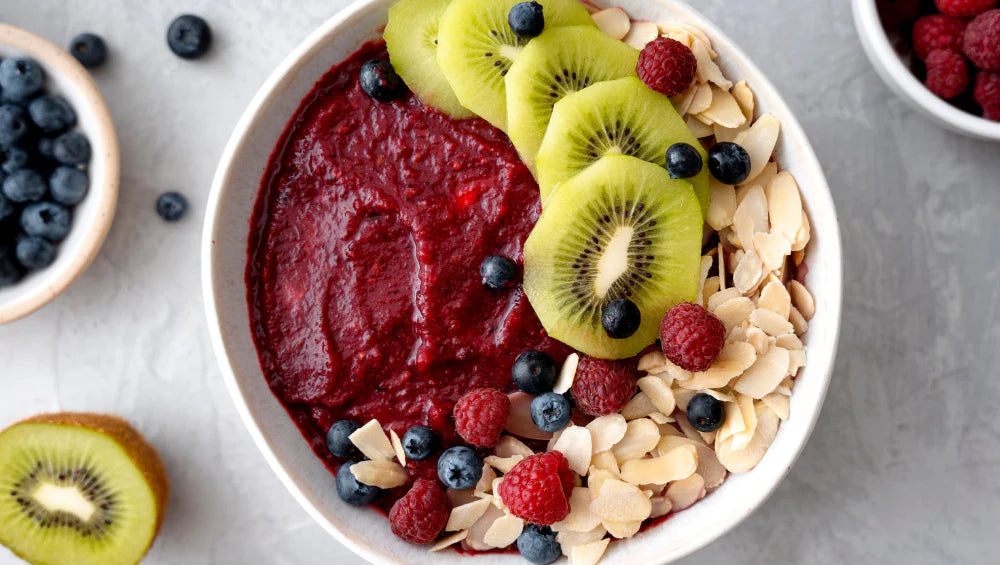
Le acai bowl correspond à une préparation épaisse obtenue en mixant de la pulpe d’açaí avec des fruits et un liquide (eau ou boisson végétale), puis servie dans un bol et garnie de différents ingrédients tels que des fruits frais, des graines ou des céréales.
Acai : bienfaits
L’açaí est souvent présenté comme un aliment à forte densité nutritionnelle. D’un point de vue analytique, sa composition se distingue par plusieurs éléments spécifiques.
Sur le plan macronutritionnel, la pulpe d’açaí contient :
- une proportion modérée de glucides, principalement issus de fibres et de sucres naturellement présents,
- une teneur en lipides plus élevée que celle de la majorité des fruits, composée en grande partie d’acides gras insaturés (notamment acide oléique),
- une faible quantité de protéines, comme la plupart des fruits.
Sur le plan micronutritionnel, l’açaí apporte :
- des fibres alimentaires, participant à la structure du fruit,
- des composés phénoliques, dont des anthocyanines, responsables de sa couleur violette intense,
- des minéraux présents en faibles quantités (comme le potassium ou le calcium).
Acai bowl recette : comment le préparer simplement ?
Temps de préparation
- Temps total : environ 5 à 10 minutes
- Niveau de difficulté : facile
- Matériel nécessaire : blender ou mixeur puissant
Ce temps de préparation court explique en partie le succès du acai bowl, qui peut être consommé aussi bien au petit-déjeuner que comme collation, y compris dans un contexte de vie active ou de pratique sportive.
Ingrédients de base recommandés
Pour une version simple et équilibrée, les ingrédients suivants constituent une base cohérente sur le plan nutritionnel :
- 100 g de pulpe d’açaí surgelée non sucrée
- ½ banane, utilisée principalement pour la texture et la douceur naturelle
- 50 ml de lait végétal ou d’eau, à ajuster selon la consistance souhaitée
- une poignée de fruits rouges (frais ou surgelés)
L’ensemble est mixé jusqu’à l’obtention d’une texture épaisse et homogène, proche d’un sorbet. Cette consistance est caractéristique du acai bowl et permet de maintenir les toppings en surface sans qu’ils ne s’enfoncent.
Choisir les bons toppings
Les garnitures jouent un rôle important dans l’équilibre nutritionnel final du bowl. Leur choix doit être réfléchi, en fonction des besoins énergétiques et des objectifs individuels.
À privilégier :
- graines de chia ou de lin, pour leur apport en fibres,
- fruits frais, pour compléter l’apport en glucides,
- oléagineux nature (amandes, noix, noisettes),
- yaourt nature ou skyr, afin d’ajouter une source de protéines.
À limiter :
- granolas industriels riches en sucres ajoutés,
- sirops ou nappages sucrés,
- accumulation excessive de toppings, qui augmente rapidement l’apport calorique.
L’objectif est de préserver un équilibre nutritionnel cohérent, en évitant de transformer le acai bowl en dessert très sucré. Une composition maîtrisée permet d’obtenir une préparation adaptée à une consommation régulière, notamment dans un cadre sportif ou de nutrition quotidienne.
Acai bowl : recette adaptée avant ou après l’entraînement
Selon le moment de consommation, la composition d’un acai bowl peut être ajustée afin de mieux répondre aux besoins nutritionnels liés à l’activité physique. L’objectif reste d’adapter les apports en glucides, lipides et protéines.
Recette d’acai bowl avant l’entraînement
Objectif nutritionnel :Apporter une source de glucides, avec un apport protéique modéré.
Temps de préparation : 5 à 10 minutes
Ingrédients recommandés :
- 100 g de pulpe d’açaí surgelée non sucrée
- 1 fruit au choix (selon tolérance et préférences) :
- banane
- mangue
- poire - fruits rouges supplémentaires
- 50 à 70 ml d’eau ou de boisson végétale
- une poignée de fruits rouges
Source de protéines (au choix) :
- yaourt végétal enrichi en protéines,
- skyr ou fromage blanc (petite portion),
- protéine végétale nature (sans arôme, quantité modérée).
Toppings conseillés :
- fruits frais coupés,
- flocons d’avoine fins (portion contrôlée),
- graines de chia ou de lin.
À noter : Les alternatives à la banane permettent d’adapter la recette aux préférences gustatives ou aux sensibilités digestives.
Recette d’acai bowl après l’entraînement
Objectif nutritionnel : Obtenir une préparation plus complète, intégrant une source de protéines adaptée à une consommation post-effort.
Temps de préparation : 5 à 10 minutes
Ingrédients recommandés :
- 100 g de pulpe d’açaí surgelée non sucrée
- ½ fruit au choix :
- banane
- poire
- mangue
- pomme cuite ou crue (selon tolérance)
- 50 ml de lait (animal ou végétal)
- une poignée de fruits rouges
Source de protéines (au choix) :
- skyr, fromage blanc ou yaourt nature,
- protéine végétale ou protéine de lactosérum nature,
- tofu soyeux (option végétale).
Toppings conseillés :
- oléagineux nature (amandes, noix, en quantité modérée),
- graines de courge ou de tournesol,
- copeaux de noix de coco non sucrés (petite quantité).
À noter : Après l’entraînement, l’ajout d’une source protéique permet d’équilibrer la préparation sur le plan nutritionnel. Le choix du fruit peut être adapté afin de varier les apports en glucides et d’éviter une consommation systématique de banane.
Adapter les recettes selon le profil et les préférences
Les recettes proposées constituent des bases modulables. Les quantités et les ingrédients peuvent être ajustés en fonction :
- du type d’activité physique pratiquée,
- de l’intensité et de la durée de l’effort,
- des préférences alimentaires,
- des tolérances digestives individuelles.
Cette approche permet de conserver un acai bowl simple, adaptable et cohérent, compatible avec une alimentation équilibrée, sans excès ni promesse non étayée scientifiquement.
Calories de l’acai bowl : ce qu’il faut réellement savoir
Un apport énergétique très variable selon la composition
L’une des idées reçues les plus courantes concerne les calories de l’acai bowl. Contrairement à ce que l’on pourrait penser, il n’existe pas de valeur calorique standard. L’apport énergétique d’un acai bowl dépend entièrement :
- des ingrédients utilisés,
- des quantités ajoutées,
- du type de toppings choisis.
La base à l’açaí, souvent perçue comme légère, peut rapidement devenir plus énergétique dès lors que des fruits supplémentaires, des céréales ou des matières grasses sont incorporés.
À titre indicatif, pour des portions couramment utilisées :
- Pulpe d’açaí pure (100 g) : environ 70 kcal
- Banane moyenne : environ 90 kcal
- Granola (30 g) : environ 120 à 140 kcal
- Beurre d’oléagineux (1 cuillère à soupe) : environ 100 kcal
En pratique, un acai bowl peut ainsi fournir entre 250 et plus de 600 kcal. Selon sa composition, il peut correspondre :
- à une collation,
- à un petit-déjeuner,
- ou à un repas à part entière.
La notion de “calories” ne doit donc pas être interprétée isolément, mais replacée dans le contexte global de l’alimentation quotidienne.
Acai bowl et objectifs sportifs
L’intérêt nutritionnel d’un acai bowl varie selon le moment de consommation et les objectifs poursuivis.
- Avant l’entraînement : Une version modérée en matières grasses et centrée sur les fruits peut contribuer à l’apport énergétique préalable à l’effort, à condition de respecter un temps de digestion suffisant.
- Après l’entraînement : Une préparation intégrant une source de protéines permet d’obtenir une composition plus complète, mieux adaptée à une consommation post-effort.
- Objectif de perte de masse grasse : Une attention particulière doit être portée aux portions et aux toppings ajoutés, afin d’éviter un apport énergétique excessif.
- Objectif de prise de masse : Le acai bowl peut constituer une option pratique et dense sur le plan énergétique, notamment lorsqu’il est enrichi en glucides et en protéines.
Le principal enjeu réside donc dans l’adéquation entre la composition du bowl, le moment de consommation et l’objectif nutritionnel individuel. Une approche personnalisée reste essentielle pour intégrer le acai bowl de manière cohérente dans une alimentation équilibrée.
Acai bowl et autres bowls : quelles différences ?
L’acai bowl se rapproche du smoothie bowl classique, mais certaines caractéristiques le distinguent :
- Profil nutritionnel particulier : l’acai apporte naturellement des lipides issus d’acides gras insaturés, ce qui peut rendre sa composition lipidique plus élevée que celle de la plupart des fruits utilisés dans un smoothie bowl.
- Texture dense et épaisse : la pulpe d’açaí mixée avec peu de liquide donne une consistance proche du sorbet, permettant de maintenir les toppings à la surface.
- Couleur et profil gustatif : la teinte violette de l’açaí, ainsi que sa saveur légèrement terreuse et fruitée, le différencient des autres fruits couramment utilisés dans les smoothie bowls, comme la mangue, la fraise ou la banane.
Le choix entre acai bowl, smoothie bowl ou autres préparations dépend avant tout du moment de consommation et des besoins énergétiques et nutritionnels individuels. Par exemple :
- pour un apport rapide en glucides avant l’effort, un smoothie bowl à base de fruits doux et peu gras peut être privilégié,
- pour une préparation plus dense et consistante, l’acai bowl constitue une option adaptée, notamment pour un petit-déjeuner complet ou une collation gourmande.
Les erreurs fréquentes à éviter avec l’acai bowl
Bien que l’acai bowl soit souvent perçu comme une préparation légère et saine, certaines erreurs courantes peuvent limiter son intérêt nutritionnel ou rendre sa consommation moins adaptée aux objectifs individuels. Parmi elles :
- Considérer l’acai bowl comme systématiquement « léger »
L’apport calorique varie fortement selon la base et les toppings utilisés. Il est donc important d’évaluer les ingrédients et les portions plutôt que de supposer qu’un bowl reste faible en calories.
- Multiplier les toppings sans contrôle
L’ajout excessif de granola, de beurre d’oléagineux ou de sirops peut transformer le bowl en préparation très énergétique, modifiant son rôle dans la journée.
- Utiliser des produits transformés ou sucrés
Certains ingrédients industriels peuvent contenir des sucres ajoutés ou des matières grasses de faible qualité, ce qui réduit la cohérence nutritionnelle de la préparation.
- Négliger l’apport en protéines dans un contexte sportif
Pour les repas avant ou après l’effort, intégrer une source de protéines permet de compléter le bowl et de mieux répondre aux besoins énergétiques liés à l’activité physique.
Un acai bowl reste un outil alimentaire polyvalent, qui gagne à être utilisé avec discernement. Adapter la composition à ses besoins, au moment de consommation et aux objectifs nutritionnels permet de tirer pleinement parti de cette préparation tout en conservant un équilibre global dans l’alimentation.
L’acai bowl est-il adapté à tous les profils ?
L’acai bowl est une préparation versatile qui peut convenir à différents types de consommateurs, à condition d’adapter sa composition et ses portions.
Profils pour lesquels il est pertinent
- Sportifs réguliers : en raison de son apport en glucides modulable et de sa texture, il peut être intégré avant ou après l’entraînement.
- Personnes actives : il constitue une option pratique pour un petit-déjeuner ou une collation rapide, permettant d’apporter des glucides et des fibres.
- Individus recherchant une collation complète : sa combinaison de fruits, graines et éventuellement de protéines en fait une préparation polyvalente et satisfaisante.
Précautions à prendre
- Allergies alimentaires : vérifier la présence de fruits à coque, graines ou autres ingrédients susceptibles de déclencher des réactions allergiques.
- Contrôle des portions : en raison de la variabilité énergétique selon les ingrédients et les toppings, il est recommandé d’adapter la quantité consommée aux besoins individuels.
- Choix des ingrédients : privilégier des produits peu transformés et limiter les ajouts sucrés ou industriels pour conserver un équilibre nutritionnel optimal.
Acai bowl, recettes et conseils pour sportifs : en résumé
L’acai bowl est une préparation polyvalente, facile à personnaliser et adaptée à différents profils, qu’il s’agisse de sportifs réguliers, de personnes actives ou de toute personne recherchant une collation complète et équilibrée. Sa texture épaisse, sa base fruitée et la possibilité d’ajouter des toppings variés permettent de moduler l’apport énergétique et nutritionnel selon le moment de consommation et les besoins individuels.
Pour tirer pleinement parti de cette préparation, il est recommandé de privilégier des ingrédients frais ou peu transformés, d’adapter les portions et les toppings aux objectifs, et d’intégrer une source de protéines lorsque cela est pertinent, notamment après l’effort. La variation des fruits et des garnitures permet également de diversifier les saveurs et la composition nutritionnelle du bowl.

