

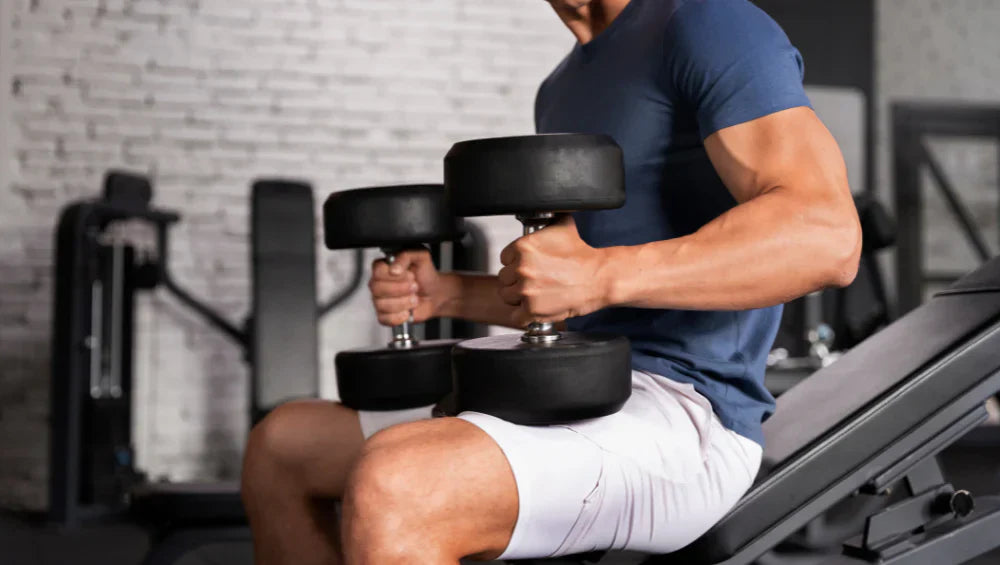
La musculation avec des haltères permet de s’entraîner n’importe où, avec peu de matériel, tout en ciblant l’ensemble des groupes musculaires. Que vous soyez débutant ou confirmé, l’haltère offre une grande liberté de mouvement, favorise un travail musculaire équilibré et s’adapte à tous les objectifs : prise de masse, tonification, renforcement ou maintien.
Dans ce guide, vous découvrirez des exercices essentiels, des programmes adaptés à chaque niveau, et des conseils pratiques pour progresser efficacement, chez vous ou en salle, en toute sécurité.
Sommaire
Pourquoi faire de la musculation avec haltère ?
La musculation avec haltères reste l’un des moyens les plus efficaces, accessibles et polyvalents pour renforcer l’ensemble du corps. Que vous soyez débutant à la maison ou athlète confirmé en salle, les haltères s’adaptent à tous les niveaux, objectifs et contraintes.
1. Une liberté de mouvement totale
Contrairement aux machines guidées, les haltères vous laissent libre de vos gestes. Cette liberté permet d’effectuer un mouvement plus naturel et d’adapter l’amplitude selon votre morphologie ou vos limitations.
Par exemple, lors d’un développé couché avec haltères, vous pouvez légèrement ajuster la trajectoire pour mieux cibler vos pectoraux ou soulager vos épaules.
2. Un recrutement musculaire plus complet
L’utilisation des haltères mobilise activement les muscles stabilisateurs. À chaque mouvement, votre corps doit stabiliser les charges indépendamment à droite et à gauche, sollicitant davantage de fibres musculaires et améliorant la coordination intermusculaire.
3. Une symétrie musculaire mieux respectée
En musculation, les déséquilibres entre le côté gauche et droit sont fréquents, surtout avec une barre. Les haltères obligent chaque côté du corps à produire un effort équivalent. Cela permet :
- D’éviter les compensations,
- De corriger les asymétries,
- De prévenir les blessures liées à un surmenage d’un seul côté.
4. Une solution idéale pour s'entraîner chez soi
Les haltères ne nécessitent ni installation complexe ni espace dédié. Une paire de poids ajustables ou progressifs suffit pour travailler tout le corps efficacement. Ce type d'entraînement est donc idéal pour les personnes :
- Qui n’ont pas accès à une salle de sport,
- Qui manquent de temps,
- Ou qui souhaitent s'entraîner en toute autonomie à domicile.
À noter : les haltères peuvent être combinés à un banc inclinable, mais ce n’est pas obligatoire. De nombreux exercices se pratiquent debout, assis ou au sol.
5. Une adaptabilité à tous les objectifs
Que vous souhaitiez :
- Prendre du muscle (hypertrophie),
- Perdre du gras,
- Gagner en force,
- Renforcer votre posture,
- Ou simplement bouger plus au quotidien.
La musculation avec haltères peut être adaptée en jouant sur le poids, le nombre de répétitions, la vitesse d’exécution, ou encore le temps de repos. C’est un outil ultra flexible qui répond à tous les objectifs de condition physique.

Créatine - Essential Supp
Sale price32,90€
Prework no stim - Io Genix
Sale price26,90€
Exercices de musculation haltères : techniques, exécution et temps de repos
1. Musculation biceps haltère
- Curl classique debout
Mouvement :
- Debout, un haltère dans chaque main, paumes tournées vers l’avant.
- Pliez les coudes pour remonter les haltères jusqu’aux épaules, puis redescendez lentement en contrôlant.
Conseil : Gardez les coudes proches du corps, évitez de balancer le dos.
Temps de repos : 45 à 60 secondes entre les séries.
- Curl marteau
Mouvement :
- Même position de départ, mais les paumes restent face au corps tout au long du mouvement.
- Montez les haltères en gardant cette prise neutre.
Ciblage : Ce mouvement sollicite davantage le brachial antérieur.
Temps de repos : 60 secondes.
- Curl concentration unilatéral
Mouvement :
- Assis sur un banc, coude appuyé à l’intérieur de la cuisse.
- Remontez l’haltère jusqu’à l’épaule, puis redescendez en contrôlant.
Objectif : Accentuer l’isolement du biceps.
Temps de repos : 30 à 45 secondes entre les bras.
Ces exercices peuvent être intégrés dans une séance bras ou en complément d’un entraînement haut du corps.
2. Musculation triceps haltère
- Kickback triceps
Mouvement :
- Penchez-vous en avant, dos droit, bras le long du corps.
- En gardant le bras immobile, tendez l’avant-bras en arrière jusqu’à ce qu’il soit aligné au bras, puis revenez lentement.
Temps de repos : 45 à 60 secondes.
- Extension verticale (overhead)
Mouvement :
- Debout ou assis, tenez un haltère à deux mains au-dessus de la tête.
- Pliez les coudes pour abaisser l’haltère derrière la tête, puis poussez vers le haut.
Attention : Gardez les coudes proches l’un de l’autre pour éviter une dispersion de la charge.
Temps de repos : 60 à 75 secondes.
- Développé couché prise serrée
Mouvement :
- Allongez-vous sur un banc.
- Tenez deux haltères au-dessus de votre poitrine, les paumes se faisant face.
- Descendez les haltères en gardant les coudes proches du corps, puis poussez vers le haut.
Particularité : Cible à la fois les triceps et les pectoraux internes.
Temps de repos : 75 secondes. Ces exercices permettent un développement équilibré des triceps tout en renforçant la stabilité du coude.
3. Musculation épaules haltère
- Élévations latérales
Mouvement :
- Debout, bras le long du corps, haltères en mains.
- Levez les bras sur les côtés jusqu’à l’horizontale, puis redescendez lentement.
Astuce : Légère flexion du coude, mouvement fluide.
Temps de repos : 45 à 60 secondes.
- Développé militaire assis ou debout
Mouvement :
- Tenez les haltères à hauteur d’épaules, paumes vers l’avant.
- Poussez au-dessus de la tête jusqu’à l’extension complète, puis revenez lentement.
Position assise : Favorise le contrôle. Debout : engage le tronc.
Temps de repos : 60 à 75 secondes.
- “Oiseau” pour l’arrière d’épaule
Mouvement :
- Penchez le buste vers l’avant, bras pendants.
- Élevez les haltères en arrière sur les côtés comme des ailes d’oiseau, puis revenez.
Important : Ne pas tirer avec le dos, concentrez-vous sur les épaules postérieures.
Temps de repos : 60 secondes. Ces mouvements participent à l’équilibre postural et à l’esthétique de l’épaule.
4. Musculation pectoraux haltère
- Développé couché
Mouvement :
- Allongé sur un banc plat, haltères en main, bras tendus au-dessus de la poitrine.
- Descendez les haltères de façon contrôlée jusqu’à la hauteur de la poitrine, puis poussez vers le haut.
Temps de repos : 75 à 90 secondes.
- Écarté couché (fly)
Mouvement :
- Allongé sur un banc, bras tendus avec une légère flexion au coude.
- Abaissez les bras sur les côtés (comme si vous écartiez une serviette) jusqu’à ressentir un étirement, puis ramenez au-dessus de la poitrine.
Attention : Mouvement lent, contrôle essentiel.
Temps de repos : 60 secondes.
- Développé incliné
Mouvement :
- Même principe que le développé couché, mais sur banc incliné (30-45°).
- Accentue le travail des pectoraux supérieurs.
Temps de repos : 75 secondes. Ces exercices sont essentiels pour une poitrine bien développée et proportionnée.
5. Musculation dos haltère
- Rowing unilatéral
Mouvement :
- Genou et main d’un côté posés sur un banc, haltère dans l’autre main.
- Tirez l’haltère vers le bas des côtes, puis redescendez.
Cible : Grand dorsal et rhomboïdes.
Temps de repos : 45 secondes par côté.
- Rowing buste penché
Mouvement :
- Debout, buste penché à 45°, haltères dans chaque main.
- Tirez les haltères en arrière vers votre taille, puis relâchez.
Attention : Garder le dos droit tout au long du mouvement.
Temps de repos : 60 secondes.
- Deadlift jambes tendues avec haltère
Mouvement :
- Debout, jambes légèrement fléchies.
- Descendez les haltères le long des jambes sans arrondir le dos, puis relevez-vous en contractant les fessiers.
Cible : Ischio-jambiers, fessiers, bas du dos.
Temps de repos : 75 à 90 secondes.
Ces mouvements renforcent la chaîne postérieure, essentielle à une bonne posture et à la performance.
6. Jambes et fessiers
- Goblet squat
Mouvement :
- Tenez un haltère contre la poitrine.
- Descendez en squat profond, genoux vers l’extérieur, puis remontez en contractant les cuisses et les fessiers.
Temps de repos : 60 à 90 secondes.
- Fentes bulgares
Mouvement :
- Un pied surélevé à l’arrière (sur un banc), l’autre au sol.
- Descendez en fente en gardant le torse droit, puis poussez pour remonter.
Ciblage : Fessiers, quadriceps.
Temps de repos : 45 à 60 secondes par jambe.
- Soulevé de terre jambes tendues
Mouvement :
- Similaire à la version pour le dos, mais avec une concentration accrue sur les ischios et les fessiers.
Temps de repos : 75 secondes.
Ces exercices permettent un travail complet du bas du corps, idéal dans un programme haltère équilibré.
Programme full body débutant (3 jours/semaine)
Ce programme est pensé pour les débutants souhaitant progresser efficacement avec des haltères. Il repose sur une répartition simple, facile à suivre, qui permet de solliciter l’ensemble des groupes musculaires tout en apprenant les bons gestes techniques. L’objectif ici n’est pas de faire du volume, mais de construire une base solide et d’installer une régularité.
1. Structure du programme
- Fréquence : 3 jours par semaine
- Durée des séances : 45 à 60 minutes
- Méthodologie : Mouvements polyarticulaires simples, avec des charges modérées, et un accent mis sur la posture, l’exécution et la respiration.
2. Jour 1 – Jambes (Quadriceps, ischios, fessiers)
L’entraînement commence par le bas du corps, afin de construire une fondation musculaire stable.
Exercices proposés :
-
Goblet squat : 3 séries de 10 répétitions
Repos : 60 à 90 secondes.
Conseil : Descendez lentement, puis poussez fort en contractant les fessiers. -
Fentes avant (alternées) : 2 séries de 10 répétitions par jambe
Repos : 60 secondes.
Conseil : Gardez le buste droit et ne laissez pas le genou dépasser les orteils. -
Soulevé de terre jambes tendues avec haltères : 3 séries de 12 répétitions
Repos : 75 secondes.
Conseil : Engagez les ischios-jambiers et évitez d’arrondir le dos. -
Élévations de mollets (debout avec haltères) : 3 séries de 15 répétitions
Repos : 30 à 45 secondes.
Conseil : Faites une pause en haut du mouvement pour maximiser la contraction.
3. Jour 2 – Pectoraux, Épaules et Triceps
Objectif : construire le haut du corps avec un focus sur les muscles moteurs de la poussée.
Exercices proposés :
-
Développé couché avec haltères : 2 séries de 8 à 10 répétitions
Repos : 60 à 75 secondes.
Conseil : Gardez les pieds à plat et descendez les haltères au niveau de la poitrine. -
Développé militaire (assis ou debout) : 2 séries de 10 répétitions
Repos : 60 secondes.
Conseil : Restez gainé pour protéger le bas du dos. -
Élévations latérales : 3 séries de 12 à 15 répétitions
Repos : 45 secondes.
Conseil : Utilisez une charge légère au début pour bien isoler les deltoïdes. -
Extension verticale triceps (overhead) : 3 séries de 10 répétitions
Repos : 60 secondes.
Conseil : Contrôlez la descente et gardez les coudes serrés. -
Kickback triceps : 3 séries de 12 répétitions par bras
Repos : 45 secondes.
Conseil : Évitez les mouvements d’élan, privilégiez la contraction musculaire.
4. Jour 3 – Dos et Biceps
Objectif : travailler la chaîne postérieure, souvent négligée chez les débutants, tout en renforçant les bras.
Exercices proposés :
-
Rowing unilatéral avec haltère : 3 séries de 10 répétitions par côté
Repos : 45 à 60 secondes.
Conseil : Concentrez-vous sur le tirage du coude plutôt que sur la main. -
Rowing buste penché à deux haltères : 2 séries de 12 répétitions
Repos : 60 secondes.
Conseil : Gardez le dos plat et évitez les mouvements de balancier. -
Curl biceps debout : 3 séries de 10 répétitions
Repos : 60 secondes.
Conseil : Ne trichez pas avec le dos, restez gainé et stable. -
Curl marteau : 2 à 3 séries de 12 répétitions
Repos : 45 à 60 secondes.
Conseil : Mouvement lent, accent sur la phase excentrique (descente).
5. Répartition hebdomadaire conseillée
- Lundi : Jambes
- Mercredi : Pectoraux, épaules et triceps
- Vendredi : Dos et biceps
Cette organisation permet de récupérer pleinement entre les séances tout en maintenant une fréquence d’entraînement efficace.
6. Conseils spécifiques pour les débutants
- Restez sur des charges modérées : L’objectif est de maîtriser les mouvements, pas de soulever lourd trop vite.
- Travaillez sur l’amplitude complète : Evitez les demi-répétitions, chaque mouvement doit être exécuté avec contrôle.
- Récupération et hydratation : Ne sous-estimez pas l’importance du repos, notamment pour les articulations encore en adaptation.
- Écoutez votre corps : Douleurs articulaires, fatigue excessive ou perte de motivation sont des signaux à ne pas négliger.


Flavored Oatmeal - Io Genix
Sale price7,90€


Isolate gourmet - LifePro
Sale price80,91€
Regular price89,90€
Programme full body intermédiaire (4 jours/semaine)
Ce programme de musculation avec haltères est conçu pour les pratiquants de niveau intermédiaire souhaitant développer harmonieusement l’ensemble du corps, en répartissant l’entraînement sur 4 jours. Chaque séance est axée sur un groupe musculaire spécifique, avec un volume de travail adapté à une progression continue, tout en permettant une bonne récupération.
1. Jour 1 – Pectoraux
Objectif : développer la masse musculaire des pectoraux avec une combinaison de mouvements de poussée et d’ouverture.
Exercices proposés :
- Développé couché avec haltères : 4 séries de 8 à 10 répétitions
- Développé incliné avec haltères : 3 séries de 10 à 12 répétitions
- Écarté couché (fly) : 3 séries de 12 à 15 répétitions
- Développé couché prise serrée (ciblant aussi les triceps) : 3 séries de 10 répétitions
Repos entre les séries : 60 à 90 secondes.
Conseil : Concentrez-vous sur la contraction des pectoraux en phase concentrique, et contrôlez bien la descente.
2. Jour 2 – Dos
Objectif : renforcer le dos et la chaîne postérieure pour améliorer la posture et l’équilibre musculaire.
Exercices proposés :
- Rowing unilatéral avec haltère : 4 séries de 10 répétitions par bras
- Rowing buste penché : 3 séries de 12 répétitions
- Deadlift jambes tendues avec haltères : 3 séries de 10 à 12 répétitions
- Pullover avec haltère (facultatif) : 2 à 3 séries de 12 répétitions
Repos entre les séries : 60 à 75 secondes.
Conseil : Maintenez une bonne posture (dos plat) et engagez les omoplates à chaque tirage.
3. Jour 3 – Bras et Épaules
Objectif : cibler les biceps, triceps et les trois portions du deltoïde pour des bras puissants et des épaules bien dessinées.
Exercices pour les biceps :
- Curl classique debout : 4 séries de 10 à 12 répétitions
- Curl marteau : 3 séries de 10 répétitions
- Curl concentration unilatéral : 2 à 3 séries de 12 répétitions par bras
Exercices pour les triceps :
- Extension verticale au-dessus de la tête : 3 séries de 10 répétitions
- Kickback triceps : 3 séries de 12 répétitions
Exercices pour les épaules :
- Développé militaire (assis ou debout) : 4 séries de 8 à 10 répétitions
- Élévations latérales : 3 séries de 12 à 15 répétitions
- “Oiseau” pour l’arrière d’épaule : 3 séries de 15 répétitions
Repos entre les séries : 45 à 60 secondes.
Conseil : Variez les angles et les prises pour solliciter les bras sous différents axes et améliorer la symétrie musculaire.
4. Jour 4 – Jambes et fessiers
Objectif : développer la force du bas du corps, travailler les quadriceps, ischios et fessiers, tout en renforçant la stabilité.
Exercices proposés :
- Goblet squat : 4 séries de 12 répétitions Fentes bulgares : 3 séries de 10 répétitions par jambe
- Soulevé de terre jambes tendues : 3 séries de 10 à 12 répétitions
- Élévations de mollets avec haltères (facultatif) : 3 séries de 15 à 20 répétitions
Repos entre les séries : 60 à 90 secondes
Conseil : Maintenez un bon alignement genou-cheville pendant les squats et les fentes pour éviter les blessures.
5. Organisation hebdomadaire conseillée
Voici une suggestion de répartition :
- Lundi : Pectoraux
- Mardi : Dos Mercredi : Repos ou activité légère (mobilité, marche, yoga)
- Jeudi : Bras et épaules
- Vendredi : Jambes
- Samedi / Dimanche : Repos ou récupération active
Cette structure permet un volume d’entraînement équilibré, une bonne répartition de la charge musculaire, et une récupération optimale.
Programme expert Push / Pull / Legs (3 jours + 1 jour repos)
Le split Push / Pull / Legs (PPL) est l’une des structures d’entraînement les plus populaires et efficaces pour les pratiquants expérimentés. Il permet de cibler les groupes musculaires en synergie, tout en optimisant la fréquence d’entraînement et la récupération. Avec une rotation de 3 jours d’entraînement suivis d’un jour de repos, ce format s’adapte parfaitement à un rythme soutenu sans sacrifier la performance.
1. Structure générale du programme
Ce programme repose sur une logique simple mais puissante :
- Jour 1 : Push - Pectoraux, épaules, triceps
- Jour 2 : Pull - Dos, biceps
- Jour 3 : Legs - Jambes (quadriceps, ischios, fessiers, mollets)
- Jour 4 : Repos
- Jour 5 : Push
- Jour 6 : Pull
- Jour 7 : Legs
-
Jour 8 : Repos
(Puis le cycle recommence.)
Ce modèle permet d’entraîner chaque groupe musculaire deux fois tous les huit jours, ce qui est idéal pour stimuler la croissance musculaire tout en laissant un temps de récupération suffisant.
2. Jour 1 & 5 – Push (Pectoraux, épaules, triceps)
Objectif : développer la force et le volume des muscles de la poussée, en priorisant les pectoraux tout en incluant les deltoïdes et les triceps.
Exercices proposés :
-
Développé couché avec haltères : 4 séries de 8 à 10 répétitions
Repos : 90 secondes.
Conseil : Contrôlez la descente pour maximiser la tension musculaire. -
Développé incliné avec haltères : 3 séries de 10 répétitions
Repos : 75 secondes.
Conseil : Orientez légèrement les paumes pour soulager les épaules. -
Écarté couché : 3 séries de 12 répétitions
Repos : 60 secondes.
Conseil : Gardez une légère flexion des coudes, ne descendez pas trop bas. -
Développé militaire (assise ou debout) : 4 séries de 8 à 10 répétitions
Repos : 75 à 90 secondes.
Conseil : Pensez à gainer le tronc pour protéger le bas du dos. -
Élévations latérales : 3 séries de 12 à 15 répétitions
Repos : 45 secondes.
Conseil : Charge légère, exécution contrôlée pour bien isoler les deltoïdes. -
Extension verticale triceps : 3 séries de 10 répétitions
Repos : 60 secondes. -
Kickback triceps : 3 séries de 12 répétitions par bras
Repos : 45 à 60 secondes.
3. Jour 2 & 6 – Pull (Dos, biceps)
Objectif : renforcer la chaîne postérieure avec des exercices de tirage, en sollicitant intensément le dos et les biceps.
Exercices proposés :
-
Rowing unilatéral avec haltère : 4 séries de 10 répétitions par bras
Repos : 60 à 75 secondes.
Conseil : Tirez avec le coude pour éviter de trop mobiliser le biceps. -
Rowing buste penché avec deux haltères : 3 séries de 12 répétitions
Repos : 60 secondes.
Conseil : Gardez le dos neutre, sans arrondir. -
Deadlift jambes tendues : 3 séries de 10 répétitions
Repos : 90 secondes.
Conseil : Focus sur les ischios et fessiers, ne creusez pas le dos. -
Pullover haltère : 3 séries de 12 répétitions
Repos : 60 secondes.
Conseil : Allongez bien la cage thoracique pour une meilleure amplitude. -
Curl biceps debout : 4 séries de 10 répétitions
Repos : 60 secondes. -
Curl marteau : 3 séries de 12 répétitions
Repos : 45 secondes.
Conseil : Bon engagement du brachial antérieur, complément idéal du curl classique.
4. Jour 3 & 7 – Legs (Jambes)
Objectif : travailler tous les groupes musculaires du bas du corps pour une croissance équilibrée et fonctionnelle.
Exercices proposés :
-
Goblet squat : 4 séries de 12 répétitions
Repos : 75 à 90 secondes.
Conseil : Veillez à descendre suffisamment bas, dos droit, talons au sol. -
Fentes bulgares : 3 séries de 10 répétitions par jambe Repos : 60 secondes.
Conseil : Gardez le torse droit et la descente contrôlée. -
Soulevé de terre jambes tendues : 3 séries de 10 répétitions
Repos : 90 secondes.
Conseil : Mobilisez les ischios et fessiers, sans extension excessive. -
Élévations de mollets debout : 3 séries de 15 à 20 répétitions
Repos : 45 secondes.
Conseil : Pause d’une seconde en haut du mouvement pour recruter les fibres profondes.
5. Jour 4 & 8 – Repos (ou récupération active)
Le jour de repos est essentiel pour permettre au système nerveux central, aux muscles et aux articulations de se régénérer. Cela peut également être l’occasion de :
- Marcher ou faire du vélo à faible intensité,
- S’hydrater correctement et bien dormir.
6. Recommandations pour les pratiquants avancés
- Pensez à la surcharge progressive : Ajoutez du poids ou augmentez les répétitions chaque semaine.
- Adaptez le volume selon vos objectifs : Prise de masse, force, ou définition musculaire.
- Utilisez un journal d’entraînement pour suivre votre progression et ajuster les cycles.
- Intégrez une rotation d’exercices toutes les 4 à 6 semaines pour éviter la stagnation.
- Ajoutez suffisamment de macronutriments et micronutriments dans votre alimentation ( protéines, glucides, lipides, vitamines, minéraux…).
7. Pourquoi ce programme est adapté aux experts ?
- Volume d’entraînement élevé, bien réparti sur la semaine
- Double fréquence musculaire (chaque groupe est travaillé deux fois tous les 8 jours)
- Excellente récupération grâce aux jours de repos intercalés
- Grande variété de mouvements pour solliciter tous les angles musculaires
Ressources et équipements conseillés
- Haltères ajustables ou fixes (fonte, néoprène) selon votre budget
- Banc modulable si l’espace le permet
- Tapis de sol pour le confort
- Carnet ou app pour suivre vos performances
Musculation haltère, s’entraîner chez soi ou en salle : en résumé
La musculation avec haltère est une méthode accessible, efficace et adaptable à tous les niveaux. Elle permet de travailler l’ensemble des groupes musculaires, avec peu de matériel, que ce soit à domicile ou en salle. Grâce à sa polyvalence, elle favorise une meilleure amplitude, un renforcement musculaire équilibré, et une progression durable.
Qu’il s’agisse de prise de masse, de tonification ou d’entretien physique, les programmes avec haltères présentés ici répondent à des objectifs variés. L’essentiel reste de s’entraîner avec régularité, de respecter la technique, et d’ajuster progressivement les charges.
Avec une bonne planification et un suivi rigoureux, la musculation haltère peut devenir une base solide pour transformer efficacement son corps sur le long terme